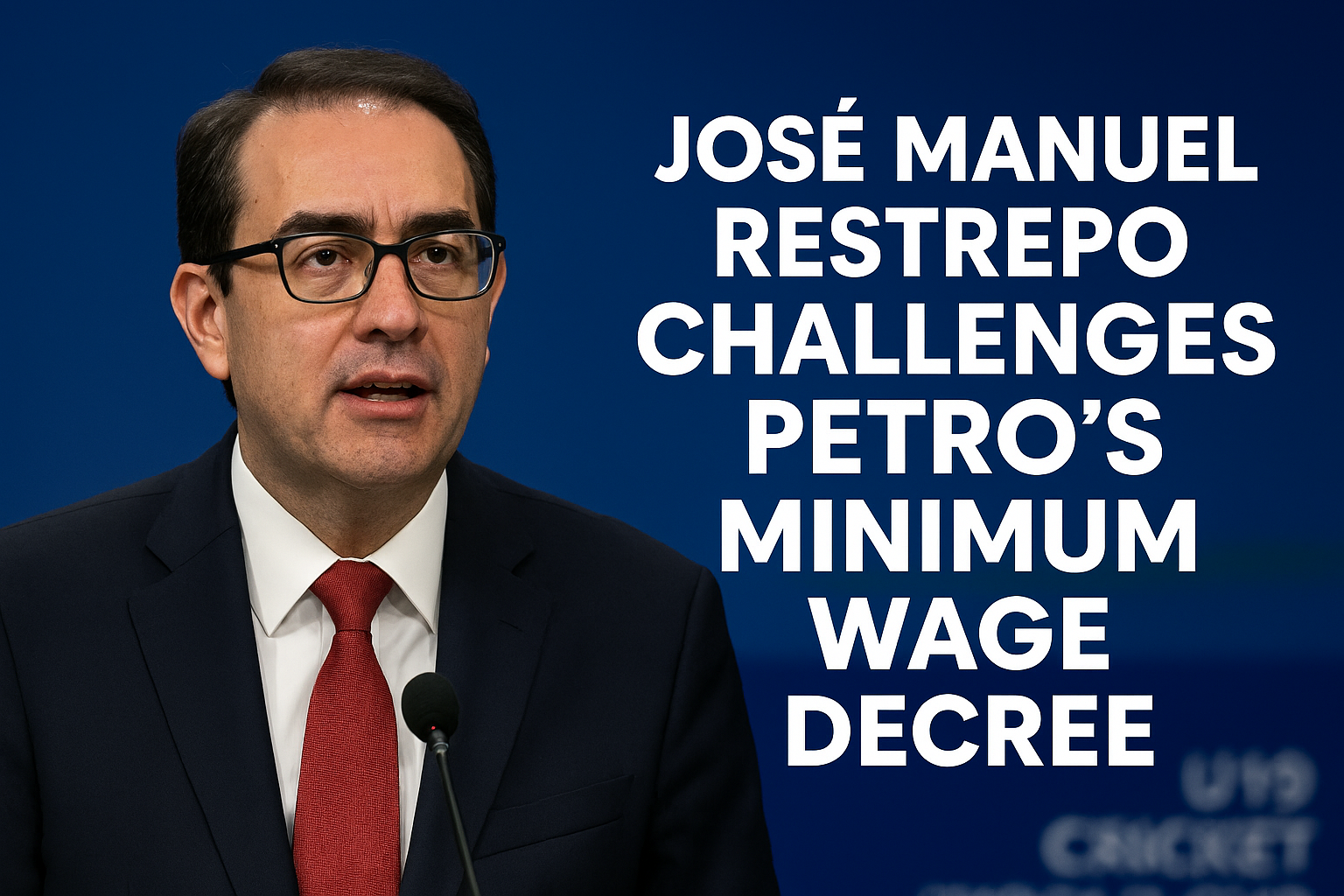
Former Finance Minister José Manuel Restrepo Challenges Petro’s 2026 Minimum Wage Decree Before Colombia’s Council of State
In a bold move that has stirred national debate, José Manuel Restrepo, Colombia’s former Minister of Finance and Commerce, has formally requested the Council of State to suspend the minimum wage decree issued by President Gustavo Petro for 2026. Restrepo argues that the decree lacks sufficient technical justification and could have damaging economic consequences for the country.
—
🇨🇴 Context: Colombia’s 2026 Minimum Wage Controversy
President Petro’s administration announced a minimum wage of 2,000,000 Colombian pesos for 2026, including transport subsidies. This represents a 23% increase over the previous year’s wage, sparking concerns among economists, business leaders, and political figures.
Restrepo, who served under President Iván Duque and is currently the rector of Universidad EIA, believes the decree could negatively impact over 90% of Colombians, especially small businesses and informal workers. He claims the increase was made without adequate economic modeling or consultation with stakeholders.
—
📢 Restrepo’s Legal Challenge and Key Questions
During his appearance on Semana El Debate, Restrepo laid out his case and posed two critical questions to the Council of State:
1. Is it legally permissible for the executive branch to set the minimum wage without tripartite consensus (government, employers, and workers)?
2. What would happen if the wage increase exceeded 100%—would it still be valid without technical justification?
These questions aim to test the legal boundaries of presidential authority in economic policymaking and highlight the potential for judicial review of executive decrees.
—
📉 Economic Concerns Raised
Restrepo’s opposition is grounded in several economic concerns:
- Inflationary pressure: A sharp wage hike could drive up prices, hurting low-income households.
- Unemployment risk: Small businesses may struggle to absorb higher labor costs, leading to layoffs.
- Investment deterrence: Unpredictable wage policies could discourage foreign and domestic investment.
He emphasized that while wage increases are necessary to protect workers, they must be balanced with economic sustainability and based on rigorous data.
—
🏛️ Political and Legal Implications
This legal challenge could set a precedent for how Colombia handles wage policy in future administrations. If the Council of State agrees to suspend the decree, it may force the Petro government to renegotiate the wage level or provide stronger technical justification.
The case also reflects broader tensions between executive power and institutional checks, especially in economic governance.
—
📺 Public Reaction and Media Coverage
Restrepo’s statements have been widely covered by Colombian media, including Semana TV, where he appeared in a special segment of El Debate. His intervention has sparked conversations across political and economic circles, with some supporting his stance and others defending Petro’s populist approach to wage reform.
—
🔍 What’s Next?
The Council of State will now review Restrepo’s petition and determine whether the decree should be suspended pending further analysis. Meanwhile, the Petro administration continues to defend its decision, citing the need to boost purchasing power and reduce inequality.
This unfolding legal and political drama will be crucial in shaping Colombia’s economic trajectory in 2026 and beyond.
(source: www.semana.com/semana-tv/semana-el-debate/articulo/jose-manuel-restrepo-le-pide-al-consejo-de-estado-suspender-el-salario-minimo-decretado-por-petro-y-deja-dos-preguntas-entre-su-exposicion-de-motivos/202616/)