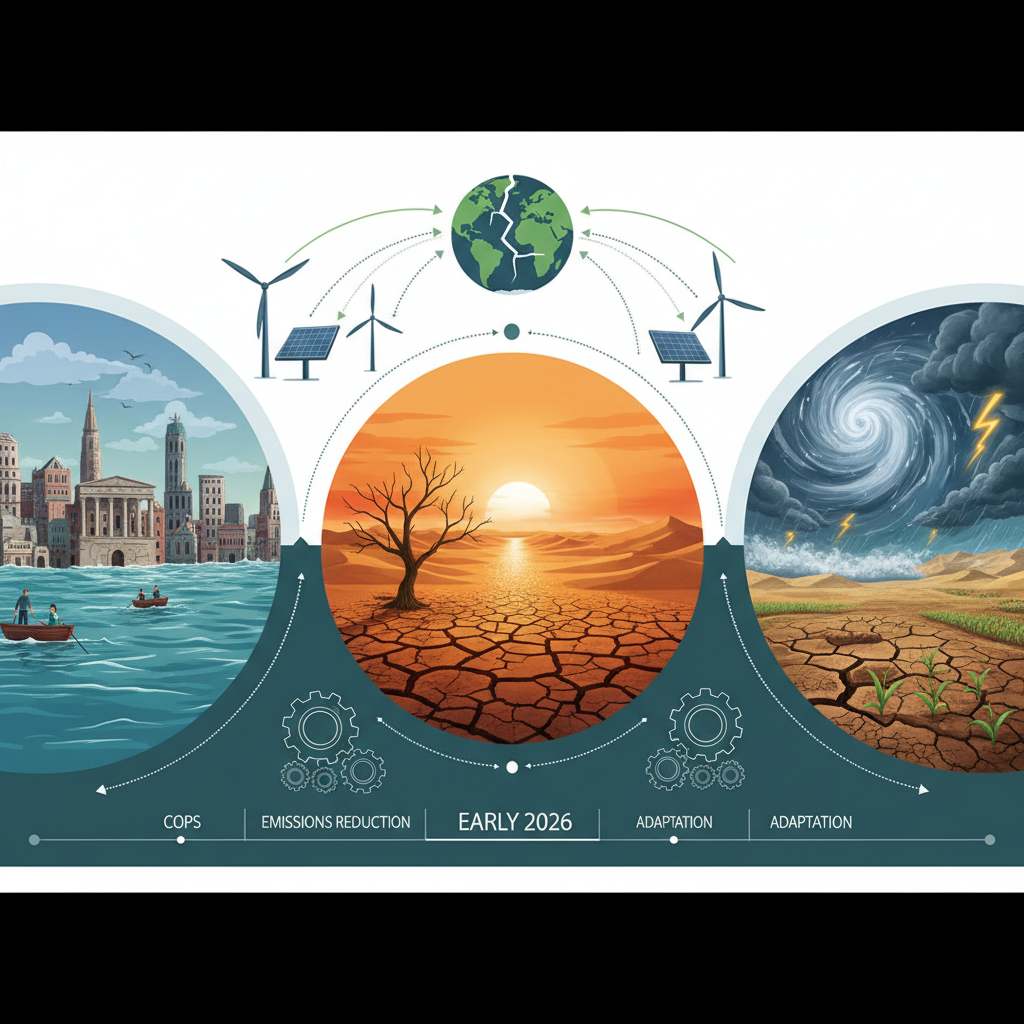
The global climate crisis is a present reality in early 2026, characterized by an alarming surge in extreme weather events and historically high temperatures. Decades of warming have led to 2023 and 2024 being confirmed as the warmest years on record, with the period 2015-2023 being the warmest nine years historically. Early 2026 is projected to continue this trend, driven by ongoing global warming and a transitioning El Niño-Southern Oscillation (ENSO) cycle.
The Unrelenting Rise: Global Temperatures Reach Critical Thresholds
Human activities are placing immense strain on Earth’s climate system, leading to record-breaking temperatures and approaching critical international agreement thresholds.
Record-Breaking Warmth and the 1.5°C Target
- 2026 Projections: Expected to be one of the hottest years on record, with temperatures projected to exceed 1.4°C above pre-industrial levels.
- 1.5°C Threshold: A real possibility of temporarily exceeding the 1.5°C Paris Agreement threshold during 2026. This would mark the fourth consecutive year surpassing 1.4°C.
- Five-Year Outlook (2025-2029): An 86% chance that at least one year will exceed 1.5°C, and a 70% chance that the five-year average warming will also exceed 1.5°C.
- Historical Context:
- 2023: Approximately 1.4°C above pre-industrial levels.
- 2024: Set a new record at 1.55 ± 0.13 °C.
- 2025: Earth’s third-warmest year since 1850.
- Paris Agreement Goal: Experts widely agree the 1.5°C goal is likely to be breached permanently by the end of the decade without immediate, drastic measures.
The Human Fingerprint on Warming
- Scientific Consensus: Rapid warming is overwhelmingly due to human activities.
- Anthropogenic Warming: Climate has already warmed by nearly 1.1°C (2 degrees Fahrenheit) since the 1850-1900 baseline due to anthropogenic emissions.
- Greenhouse Gas Levels: Unprecedented surge in greenhouse gases, with carbon dioxide, methane, and nitrous oxide reaching record highs in 2023 and continuing to increase in 2024. These are the highest levels in the last 800,000 years.
- Primary Sources: Burning of fossil fuels, deforestation, and industrial processes. These gases trap heat, driving planetary warming.
Early 2026 Weather Dynamics: ENSO Transition and Atmospheric Whiplash
Regional weather patterns in early 2026 will be influenced by the ENSO cycle and atmospheric circulation.
The Shifting ENSO Landscape
- January-March 2026: A weak La Niña (cooler-than-average equatorial Pacific sea surface temperatures) is anticipated to transition to ENSO-neutral conditions with approximately 75% probability.
- La Niña Influence: Typically associated with drier conditions in some regions and wetter in others. Its waning influence will reduce these effects.
- Late Summer/Fall 2026: Strong indication of an El Niño developing. El Niño (warm phase) is linked to warmer global temperatures and distinct shifts in rainfall and storm patterns.
Turbulent Winter Transitions in the Northern Hemisphere
- February-March 2026: Expected to experience “atmospheric whiplash” – abrupt shifts between unseasonably mild and sudden cold conditions.
- Cause: Attributed to a disrupted jet stream and the waning La Niña influence, leading to extreme fluctuations.
- Cold Snaps: While long-term trends suggest less frequent global cold extremes, short-term, localized cold snaps remain possible, causing disruption.
- Stratospheric Warming: An unusual early-season stratospheric warming in January 2026 could significantly alter late winter weather patterns by influencing the jet stream.
A Spectrum of Extremes: Regional and Global Impacts
The escalating climate crisis is causing more frequent, intense, and widespread extreme weather events globally.
Drought and Precipitation Extremes
- ENSO Impacts:
- Lingering La Niña (Spring): May elevate drought risk in central and southern plains of North America.
- Developing El Niño (Late 2026): Strongly associated with increased risk of above-average precipitation and widespread flooding in the southern US, California, and the Gulf Coast. Potential for deluge, landslides, and infrastructure damage.
- Northern US and Canada (El Niño Winter): Could lead to milder, less snowy conditions, impacting winter sports and water resources.
- Global Precipitation:
- Increase: Global average precipitation predicted to increase by 7% for each degree of warming, raising flood risk.
- Heavy Rainfall: Events expected to become more frequent and intense (4-8% per 1°C warming).
- Drought: Some regions will experience longer drought periods, exacerbating water scarcity, food insecurity, and wildfire risk.
Intensifying Oceanic Phenomena
- Ocean Warming: Absorbs most of the planet’s excess heat.
- Record Heat: 2024 set a new record for ocean warming, exceeding 2023.
- Acceleration: Rate of ocean warming over 2005–2024 is more than double that of 1960–2005.
- Consequences: More powerful hurricanes/typhoons, heavier rainfall, increased coastal flooding, and prolonged marine heatwaves devastating ecosystems.
- Melting Ice: Glaciers and ice sheets melting unabated contribute to accelerated sea level rise.
- Sea Level Rise: Rate has doubled since satellite measurements began, threatening coastal communities. Extreme sea-level events (once per century) projected to occur 20-30 times more frequently by 2050.
- Polar Ice Loss: Antarctic and Arctic sea ice extents remain well below average. Antarctic sea ice reached its second-lowest extent ever recorded in 2024.
Wildfires, Heatwaves, and Compound Disasters
- Wildfires: Hotter atmosphere dries landscapes, creating tinderbox conditions. Examples include devastating fires in Chile, Canada, and the western US in 2024.
- Heatwaves: Unequivocally more frequent and intense since the 1950s due to human-caused climate change. Every 0.5°C of warming increases intensity, frequency, and duration. Urbanization exacerbates severity via the “urban heat island” effect. Europe is warming twice as fast as the global average, leading to more frequent and severe heatwaves, floods, and droughts.
- Tropical Cyclones: Warmer ocean surface waters are expected to intensify tropical cyclones, potentially increasing the proportion of the most powerful storms.
- Compound Disasters: Human influence has likely increased the chance of concurrent extreme events (e.g., heatwaves and droughts, or wildfire followed by heavy rainfall and mudslides), overwhelming response capabilities.
The Urgency of Action: Responding to an Existential Threat
The scientific community’s warnings necessitate immediate and decisive action, as the costs of inaction far outweigh those of bold climate action.
Scientific Consensus and Dire Warnings
- Key Reports: Intergovernmental Panel on Climate Change (IPCC), World Meteorological Organization (WMO), and UN Environment Programme (UNEP) provide comprehensive and dire assessments.
- World Economic Forum: Global Risks Report 2026 identifies extreme weather events as the greatest long-term threat to humanity, especially for developing countries.
- Human Health Impacts (by 2050): Climate-driven events (floods, droughts, heatwaves) will significantly impact health, including respiratory illnesses, heatstroke, waterborne diseases, and mental health crises.
- IPCC Emphasis: Every increment of global warming leads to larger projected changes in extreme event frequency and intensity. All regions will increasingly face concurrent and multiple changes.
Pathways to Resilience and Emission Reduction
- Ambition Needed: Nations must deliver stronger ambition and action in climate pledges to keep the 1.5°C goal alive. Current pledges are insufficient.
- Emission Reduction Targets:
- For 1.5°C: Deep cuts of 42% in annual greenhouse gas emissions by 2030 and 57% by 2035 are needed.
- Global Peak & Reduction: Global greenhouse gas emissions need to peak before 2025 and be reduced by 43% by 2030.
- Sectoral Action: Immediate and deep emissions reductions are required across energy, industry, transport, buildings, agriculture, and forestry.
- Solutions:
- Clean Energy: Rapid adoption of solar and wind power.
- Natural Solutions: Vigorous forest conservation and reforestation programs to enhance carbon sinks.
- Other Investments: Energy efficiency, sustainable agriculture, and circular economy principles.
- Early Warning Systems: WMO and the global community are intensifying efforts to strengthen early warning systems and climate services to enhance resilience to extreme weather events.
Conclusion: A Pivotal Moment for Global Climate Action
Early 2026 highlights an escalating climate crisis with record temperatures, a dynamic ENSO cycle transitioning towards El Niño, and a surge in extreme weather. These interconnected events underscore the systemic nature of the crisis and push critical climate thresholds closer. The scientific consensus is clear: the window for meaningful action is rapidly closing. This is a pivotal moment requiring immediate, ambitious, and sustained global efforts to reduce greenhouse gas emissions, invest in renewable energy, protect ecosystems, and develop adaptation strategies. Collective action is imperative to safeguard the planet and build a resilient, sustainable world.