Introduction
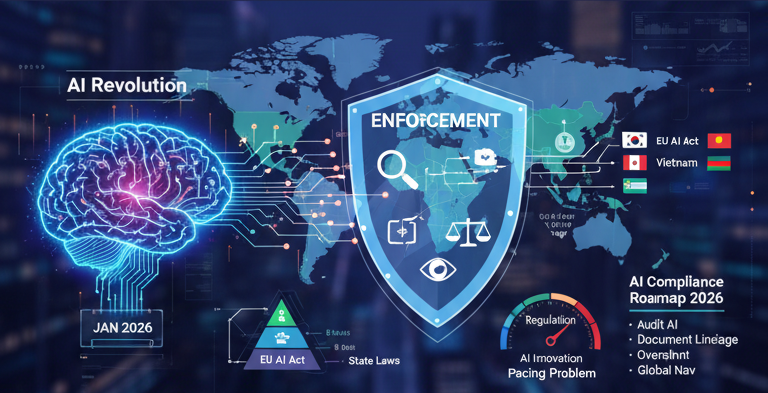
The artificial intelligence (AI) revolution is progressing at an unprecedented pace, with AI adoption and innovation accelerating across industries. By January 2026, AI has transitioned from an experimental technology to a widespread operational imperative, significantly impacting economic structures, employment, and social interactions. This widespread operationalization marks a shift from aspirational guidelines to concrete enforcement and stringent operational compliance requirements. This blog post examines the evolving global AI regulatory landscape, characterized by intensifying scrutiny, varied national approaches, and a focus on responsible innovation. It will cover the EU AI Act, the US regulatory environment, global momentum, regulatory challenges, and operational imperatives for businesses.
The EU AI Act: Setting the Global Benchmark
The European Union’s Artificial Intelligence Act is a landmark piece of legislation considered the global benchmark for AI regulation, influencing entities operating within the EU or offering AI systems to EU citizens.
Phased Implementation and Key Dates
The Act is undergoing phased implementation throughout 2026. Provisions related to prohibited AI practices are already in effect, with the most stringent rules for high-risk AI systems becoming fully applicable by August 2026.
Risk-Based Approach to Regulation
The EU AI Act employs a structured risk-based approach, categorizing AI systems by their potential to cause harm:
- Unacceptable Risk: AI systems posing a threat to fundamental rights (e.g., government social scoring, manipulative subliminal techniques) are banned.
- High Risk: AI systems in critical sectors where failure or misuse could have significant adverse impacts on individuals’ safety, rights, or livelihoods. Key sectors include:
- Health: Medical devices, diagnostic tools.
- Employment: Recruitment, performance evaluation, termination decisions.
- Education: Access to education, student performance assessment.
- Law Enforcement: Predictive policing, biometric identification.
- Limited Risk: Systems requiring transparency obligations (e.g., chatbots that users should know they are interacting with).
- Minimal Risk: The majority of AI systems (e.g., spam filters, video games) with light or no specific obligations, though voluntary codes of conduct are encouraged.
Core Mandates and Compliance
For high-risk AI systems, the Act mandates robust transparency, accountability, and human oversight throughout the technology’s lifecycle. Requirements include comprehensive data governance, risk management systems, and post-market monitoring. Non-compliance can result in substantial financial penalties, up to tens of millions of euros or a percentage of global annual turnover.
The Fragmented and Evolving US Landscape
The United States has a fragmented and dynamic regulatory environment for AI, lacking a single, comprehensive federal AI statute as of early 2026.
Absence of a Unified Federal Law
There is no overarching national framework dictating uniform AI rules across all states and industries.
Rise of State-Level Regulations
This federal vacuum has led to the emergence of numerous state-level AI laws taking effect throughout 2026, addressing specific concerns:
- California: Focuses on algorithmic discrimination in housing and employment, requiring impact assessments.
- Texas: Explores AI governance and data privacy in critical infrastructure.
- Colorado: Enacts laws on algorithmic fairness and consumer protection in insurance and lending.
- Illinois: Addresses biometric data privacy with the Biometric Information Privacy Act (BIPA), impacting AI systems using facial recognition.
- New York: Implements regulations for AI in hiring, requiring bias audits for automated employment decision tools.
These state initiatives primarily target transparency, algorithmic discrimination mitigation, and governance for high-risk AI.
Federal Intervention and Potential Conflict
In December 2025, President Trump issued an executive order to centralize federal AI action, aiming for a “minimally burdensome national standard” that balances innovation with national security and economic competitiveness. This federal intervention is expected to trigger legal challenges against existing and emerging state laws, creating jurisdictional conflicts and a complex compliance environment for businesses.
Global Momentum: Diverse Approaches, Common Threads
Nations worldwide are actively developing AI regulatory frameworks, contributing to a global shift towards governance.
International Regulatory Advancements
Countries are establishing unique AI oversight approaches:
- South Korea: Focuses on ethical guidelines, data privacy, and responsible AI innovation.
- Vietnam: Developing national strategies and legal frameworks for AI’s social and economic impacts.
- Japan: Prioritizes data utilization, ethical principles, and international collaboration with a principles-based approach.
- India: Concentrates on using AI for social good, with a need for ethical guidelines and robust data governance.
Shared Regulatory Principles
Despite diverse legal traditions, common regulatory principles are emerging globally, often mirroring the EU AI Act:
- Transparency: Clarity on AI system functioning and decision-making.
- Accountability: Clear responsibility for AI outcomes.
- Mitigation of Bias: Preventing and correcting discriminatory AI outcomes.
- Robust Data Governance: Strict rules for data collection, usage, and protection.
- Human Oversight: Maintaining meaningful human control over critical AI applications.
Impact on High-Impact Applications
Global scrutiny is particularly intense for AI in sensitive areas. Human resources technologies face pressure to demonstrate fairness, transparency, and non-discrimination, with AI tools for recruitment, performance management, and promotion subject to bias checks and evolving labor laws.
Navigating the “Pacing Problem” and Geopolitical Currents
Regulating AI faces challenges like the “pacing problem” and geopolitical complexities.
The Innovation vs. Regulation Dilemma
The “pacing problem” highlights how the rapid speed of AI innovation consistently outpaces the legislative process, potentially rendering regulations obsolete.
The Definitional Hurdle
A lack of a universally agreed-upon definition of “artificial intelligence” complicates global frameworks, leading to ambiguities and hindering international cooperation.
AI Sovereignty and Global Competition
Geopolitical currents are shaped by “AI sovereignty,” a nation’s desire to control its AI infrastructure, data, and development, viewed as critical for national security and economic power. This fuels intense global competition, particularly between the United States and China, influencing trade, technology transfer, and research direction.
Operationalizing Compliance: A 2026 Business Imperative
By 2026, effective AI governance is an operational necessity for businesses, not just a strategic advantage.
From Best Practice to Necessity
Regulatory shifts worldwide mean companies can no longer treat AI ethics and compliance as optional. Severe penalties, significant reputational risks, and public expectations demand demonstrable responsibility, making AI governance a fundamental requirement for market access and trust.
Integrating Compliance by Design
Enterprises are expected to adopt a “compliance by design” approach, embedding legal, ethical, and risk considerations from the initial conception and development phases of AI systems. This proactive integration ensures systems are built to meet regulatory requirements from the outset.
Key Actions for Businesses
Businesses must undertake several actions to navigate the complex global regulatory landscape:
- Actively auditing AI inventories: Maintain a comprehensive understanding of all AI systems, their purpose, data sources, and deployment contexts.
- Documenting model lineage: Transparently track the development, training data, and decision-making processes of AI models for accountability and explainability.
- Establishing clear oversight mechanisms: Implement robust internal governance frameworks, including AI ethics committees or review boards, for continuous monitoring and risk management.
- Navigating the increasingly complex global regulatory landscape: This requires ongoing legal counsel, continuous monitoring of evolving laws, and adapting compliance strategies to a multi-jurisdictional reality.
Conclusion
2026 represents a critical juncture where AI’s rapid ascent meets intensified global regulatory scrutiny. The shift is from abstract discussions to concrete compliance and enforcement. The EU AI Act sets a global benchmark, while the US navigates a fragmented state-level approach with federal interventions. Nations worldwide are developing their own frameworks, often converging on principles of transparency, accountability, and ethical deployment. The future will see continued evolution of AI laws, with the “pacing problem” persisting. This dynamic environment necessitates proactive business engagement, ensuring AI development is underpinned by robust governance and ethical considerations. Policymakers face the challenge of balancing innovation with protection, potentially leading to greater international collaboration or further fragmentation based on national AI sovereignty. The era of unchecked AI deployment has ended; the regulatory reckoning is here, and responsible operation is no longer optional.