By International Affairs Desk
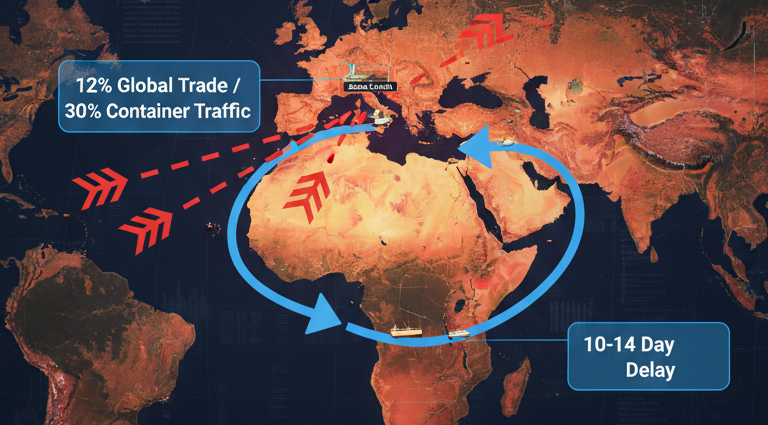
The Red Sea—one of the world’s most vital maritime corridors—has become a focal point of global economic and security concern as escalating Middle East tensions continue to disrupt commercial shipping. Carrying roughly 12% of global trade and nearly 30% of container traffic, the waterway links Europe and Asia through the Suez Canal and the Bab el-Mandeb Strait.
Since late 2023, sustained attacks by Yemen’s Houthi movement on commercial vessels have transformed the region into a high-risk zone, forcing shipping companies to reroute cargo, driving up costs, and exposing vulnerabilities in global supply chains.
How the Crisis Began
The current disruption began in October 2023, shortly after the outbreak of the Israel–Hamas war. The Houthis—an Iran-aligned armed group that controls much of northern Yemen—announced they would target vessels linked to Israel and its allies, citing solidarity with Palestinians.
What started as sporadic missile and drone attacks quickly escalated. The group has since employed anti-ship ballistic missiles, cruise missiles, explosive drones, and fast attack boats, and in some cases attempted direct boardings. The attacks have struck vessels with little or no direct connection to Israel, significantly widening the scope of risk.
A Web of Regional Conflicts
Analysts say the Red Sea crisis cannot be viewed in isolation. It sits at the intersection of several overlapping conflicts:
- The Gaza War: The Houthis have explicitly tied their attacks to the continuation of hostilities in Gaza, pledging to halt operations only if the war ends.
- Iran–Israel Proxy Tensions: The Houthis are part of Iran’s broader regional network, often referred to as the “Axis of Resistance,” which also includes armed groups in Lebanon, Iraq, and Syria.
- Yemen’s Civil War: The group’s military capacity is rooted in Yemen’s long-running internal conflict, which has enabled the Houthis to develop advanced weapons and project power beyond Yemen’s borders.
Together, these dynamics have turned the Red Sea into a pressure point in the broader Middle East confrontation.
Shipping Routes Upended
In response to the growing threat, major shipping companies—including Maersk, MSC, and Hapag-Lloyd—have diverted vessels away from the Red Sea and Suez Canal, rerouting them around Africa’s Cape of Good Hope.
The detour adds 10 to 14 days to Asia–Europe voyages, sharply increasing fuel consumption and operational costs. By early 2024, traffic through the Suez Canal had dropped by more than 50%, according to industry data.
Economic and Supply Chain Fallout
The disruption has had far-reaching economic consequences:
- Freight rates on key routes have more than doubled at times
- War-risk insurance premiums for Red Sea transit have surged
- Energy shipments to Europe have faced delays
- Automotive, electronics, and agricultural supply chains have been strained
Manufacturers reliant on just-in-time delivery systems have reported production delays, while higher transport and insurance costs are filtering through to consumer prices, adding to global inflationary pressure.
Environmental Costs Mount
The longer routes around southern Africa have also raised environmental concerns. Shipping companies are burning significantly more fuel, pushing up carbon emissions and complicating efforts to reduce the maritime sector’s climate footprint.
Industry groups warn that prolonged disruption could undermine years of progress toward greener shipping practices.
Military Response and Its Limits
The international community has responded with force. In December 2023, the United States launched Operation Prosperity Guardian, a multinational naval coalition involving the UK, France, Germany, and other partners to protect commercial shipping.
The US and UK have also conducted airstrikes on Houthi military targets in Yemen, aiming to degrade the group’s missile and drone capabilities.
Despite these efforts, the attacks have continued. By 2025, the Houthis demonstrated extended strike range, including attacks targeting Israeli territory, underscoring the difficulty of deterrence against a highly mobile and resilient force.
Risks of Escalation
Security experts warn that the growing concentration of naval forces in the Red Sea raises the risk of miscalculation or accidental escalation. Even more concerning is the possibility of spillover into other strategic chokepoints—most notably the Strait of Hormuz, through which roughly a fifth of the world’s oil supply passes.
Any disruption there would have severe global economic consequences.
Prospects for De-escalation
Diplomats say a durable solution to the Red Sea crisis depends on progress across multiple fronts:
- A sustained ceasefire in Gaza, which the Houthis have made a central condition for halting attacks
- Political stabilization in Yemen, including a negotiated end to its civil war
- Broader regional diplomacy to reduce Iran–Israel tensions
Absent movement on these issues, shipping companies are likely to continue avoiding the route.
An Uncertain Outlook
As 2026 progresses, the Red Sea remains a corridor of strategic importance—and persistent risk. While occasional lulls in violence have allowed limited transits, the underlying drivers of the crisis remain unresolved.
For global trade, the episode has become a stark reminder of how quickly geopolitical conflicts can disrupt critical infrastructure—and how deeply interconnected regional wars and the global economy have become.
Conclusion
The Red Sea shipping crisis has evolved from a regional security challenge into a global economic shock, reshaping trade routes, raising costs, and heightening geopolitical risk. Until the conflicts fuelling the instability are addressed, one of the world’s most important maritime lifelines is likely to remain under threat.