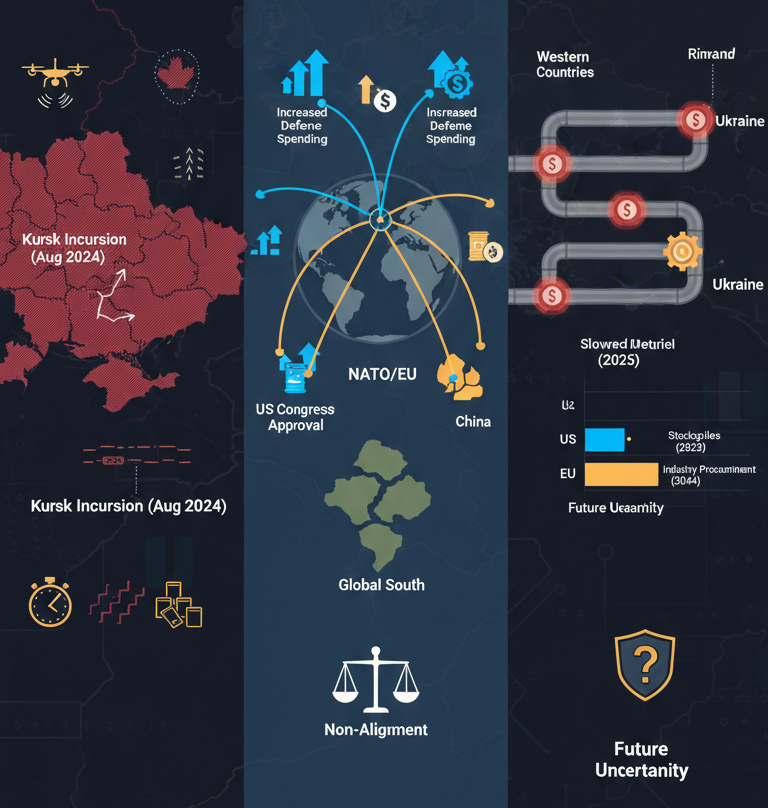
Since late 2022, the conflict in Ukraine has entered a prolonged stalemate characterized by a war of attrition, with significant frontline movement becoming rare. Russia currently occupies approximately 20% of Ukrainian territory, having made limited gains in 2024. Ukraine’s August 2024 counteroffensive into Russia’s Kursk Oblast, which briefly captured territory, has since stalled.
The Ground Reality: A Prolonged Stalemate
The defining characteristic of the war since late 2022 is an entrenched stalemate, with neither side achieving decisive breakthroughs. Ukraine’s August 2024 counteroffensive into Russia’s Kursk Oblast, while initially promising, ultimately stalled.
Key Factors Contributing to the Impasse
- Technological Factors & Ubiquitous Surveillance: The widespread use of affordable drones and advanced Intelligence, Surveillance, and Reconnaissance (ISR) assets (night vision, counter-battery radars, satellite imagery) has created a “reconnaissance-strike complex.” This allows for immediate engagement of detected targets, preventing the massing of troops and equipment necessary for breakthroughs. Both sides have adapted to drone warfare, reinforcing defensive advantages.
- Topographical Challenges: The flat, open terrain of southern Ukraine offers minimal concealment, enhancing surveillance effectiveness and making large-scale maneuvers difficult to execute undetected.
- Trench Warfare: The conflict has seen a return to extensive trench systems, a tactical shift attributed to limitations in sophisticated weaponry and the resources required for modern mobile warfare. This results in high casualties, slow advances, and static front lines.
- Manpower Issues:
- Ukraine: Faces deepening manpower shortages due to a dwindling pool of experienced infantry and mobilization challenges, leading to the recruitment of older individuals (40s-50s) requiring extensive training. Broader labor shortages exist across sectors due to conscription, desertions, and emigration.
- Russia: Despite high casualties, Russia has maintained personnel levels through methods like forced mobilization and recruitment from prison populations. Analysts estimate Russia can sustain current intensity levels for another 1-2 years.
- Logistical Challenges:
- Ukraine: Is heavily reliant on Western supply chains for critical resources like precision munitions, armored vehicles, satellite intelligence, and air defense systems. Its air defenses and infrastructure are strained by continuous Russian missile and drone attacks.
- Russia: Faces significant economic costs but has shown resilience through sanctions evasion and trade redirection.
- Strategic Objectives & Diplomatic Deadlock:
- Ukraine: Insists on reclaiming all occupied territories and securing robust security guarantees, with NATO membership as a long-term goal.
- Russia: Demands territorial concessions, recognition of its sovereignty over Crimea and annexed regions, and constraints on Ukraine’s military capabilities. These opposing objectives create a diplomatic impasse.
Reshaping the Global Order: Shifting Geopolitical Alliances
The war has profoundly altered the global geopolitical landscape, strengthening some alliances and forging new partnerships.
Strengthening of Western Alliances
- NATO: The conflict has revitalized NATO, leading to increased defense spending, bolstered deterrence, and enhanced forward presence in Eastern Europe. The integration of Finland and Sweden into NATO signifies a renewed sense of purpose. The transatlantic alliance has been reinforced, though burden-sharing discussions persist.
- European Union: The war has driven deeper integration and a more assertive geopolitical stance within the EU. The enlargement process has been revitalized with Ukraine and Moldova granted candidate status. EU member states are rearming and reducing reliance on Russian fossil fuels.
Russia’s Isolation and New Partnerships
Russia faces increased international isolation from Europe and a severe deterioration of relations with Western nations due to extensive economic sanctions. In response, Russia has deepened its strategic alignment with China, driven by a shared opposition to the United States and a mutual interest in undermining the transatlantic alliance. Russia continues to sell natural resources to China and India, generating crucial revenue and circumventing some sanctions.
The Evolving Role of China and the Global South
- China: Maintains a position of “pro-Russian neutrality,” providing significant economic and political support to Moscow without direct military aid. Beijing views Russian stability as beneficial and the conflict as a means to tie up US resources, advancing its own Indo-Pacific objectives.
- Global South: Countries like India, Brazil, and South Africa emphasize non-alignment and strategic autonomy, often abstaining from condemning Russia in UN votes. Their positions are influenced by historical alignments, economic interests (food, energy, fertilizer supply chains), and a critique of Western foreign policy, advocating for a multipolar world order. Ukraine is intensifying diplomatic efforts to counter Russian and Chinese influence in these regions. Turkey maintains a delicate diplomatic role, particularly in the Black Sea. Internal political divisions in the U.S. have led some in the Global South to question U.S. reliability as a security partner.
The Lifeline Under Scrutiny: Western Aid Debates
Western aid has been crucial for Ukraine, but its provision has become contentious and challenging, raising questions about future sustainability.
Current Challenges and Legislative Hurdles
Ukraine has experienced months of delays in U.S. and E.U. funding allocations. U.S. aid packages have stalled in Congress due to Republican opposition, linked to domestic demands like border security. Within the EU, disagreements persist regarding aid mechanisms, with Germany favoring bilateral aid and smaller states concerned about using EU facilities for equipment transfer.
There is a perceived decline in political will for long-term funding, leading to slow decision-making and shrinking aid packages. Practical difficulties include slow replenishment of depleted national stocks and politically driven bans on certain weapon types. Military aid to Ukraine has reportedly declined by 45%, with supplies arriving in smaller quantities and with delays. Aid allocation can also lead to opportunity costs, potentially reducing funding for other crucial areas like humanitarian aid.
Evolution of Military Support
Military aid saw a sharp decline in July and August 2025, with a 43% decrease in the monthly average compared to the first half of the year. Procurement methods have shifted: from over 70% of military aid coming from national stockpiles in 2022, two-thirds are now sourced directly from defense industries by 2024, indicating a need to ramp up European defense production.
- Key Providers:
- United States: Remains the largest single provider, committing approximately $65.9 billion in military assistance since February 2022, out of a total of over $85 billion from Western states.
- Germany: Is the second-largest overall military aid donor and the largest among EU member states, committing $20 billion by October 2025, with an additional $32 billion earmarked for future years.
Financial Commitments and Future Mechanisms
Total financial aid committed to Ukraine since January 2022 is substantial: the U.S. has committed approximately $175 billion, and the EU roughly $197 billion by December 2025. The EU and its member states provided over $145 billion between 2022-2024, increasing to $162 billion by mid-2025, including $65 billion in military aid. The EU also pledged over €18 billion (approximately $20 billion) for economic stabilization and reform.
Future funding discussions involve leveraging frozen Russian assets, utilizing Security Action for Europe (SAFE) loans, and ensuring long-term funding through initiatives like the Ukraine Assistance Fund (€5 billion agreed upon in March 2024). The estimated reconstruction needs for Ukraine are projected at $411 billion over a decade by the World Bank.
Uncertainties and Future Prospects of Aid
The future of Western aid faces significant uncertainties, particularly concerning political shifts. The U.S. presidential election in 2024, resulting in President-elect Donald Trump’s return to office, has raised concerns due to his opposition to further military assistance and his prioritization of a negotiated peace. Fears exist that reduced U.S. aid could lead European countries to follow suit, potentially impacting Ukraine’s combat power and leading to territorial losses.
This prospect encourages Europe to develop innovative strategies to fill potential funding gaps, institutionalize long-term military support partnerships, and strengthen Ukraine’s domestic defense industrial base. Ukraine has appealed for increased support to boost its domestic drone and missile production for deterrence.
Bilateral Security Agreements (BSAs) with the U.S. and E.U. provide a ten-year framework for security cooperation but are generally not legally binding, with funding often limited to one-year periods. The UK’s allocation of £200 million for a Multinational Force for Ukraine, contingent on a peace deal, indicates preparations for various scenarios.
Russia remains committed to its original war aims, seeking U.S. recognition of occupied territories and opposing NATO troops in Ukraine as part of any future security guarantees.
Implications and Outlook
The Ukraine war is a complex, multi-dimensional conflict impacting military strategy, global governance, and international aid. Its implications extend beyond the battlefields, reshaping alliances and challenging established norms.
The military stalemate is likely to persist as long as current capabilities, manpower levels, and strategic objectives remain unchanged. This points to continued attritional warfare with high human and resource costs.
Globally, the conflict is solidifying a multipolar world order, with emerging axes of power and influence and a renegotiation of traditional alliances. The West’s cohesion and commitment to Ukraine face a critical juncture, requiring adaptable strategies for long-term sustainability and Ukraine’s self-reliance.
Conclusion
The Ukraine War’s prolonged stalemate stems from intricate military factors, including drone surveillance, trench warfare, and manpower shortages. Simultaneously, the conflict drives significant geopolitical shifts, strengthening Western alliances, pushing Russia towards new partnerships, and influencing the Global South’s strategic autonomy. The sustainability and political will for Western aid are increasingly challenged, creating a critical crossroads for Ukraine’s future. The conflict’s repercussions are reshaping international security paradigms and global power dynamics, necessitating adaptable strategies from international actors for future stability.