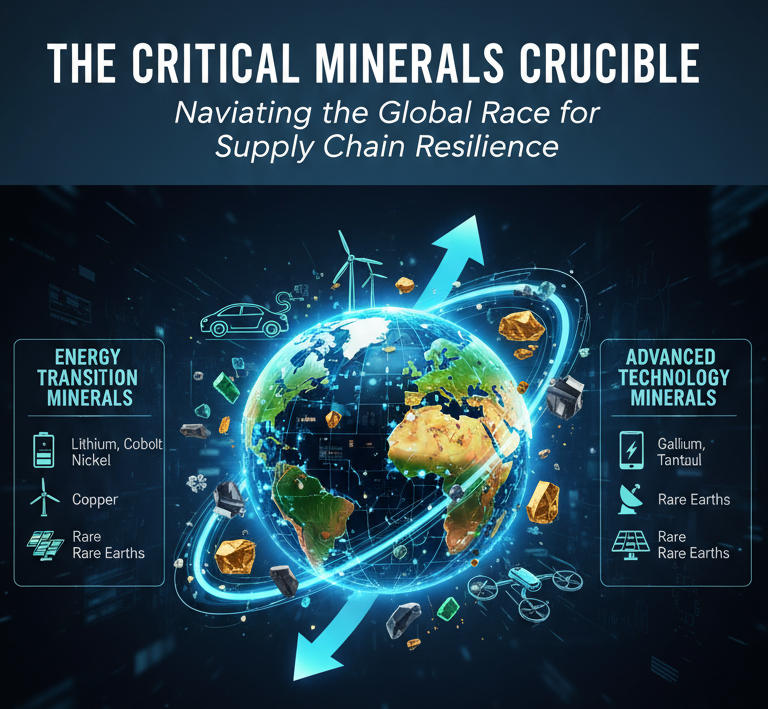
The global competition for critical minerals is intensifying, driven by the surge in demand for clean energy technologies and advanced innovations. These minerals are strategic assets vital for economic stability, national security, and industrial competitiveness, underpinning technologies from electric vehicles (EVs) and wind turbines to smartphones and defense systems. Nations are pursuing multifaceted strategies to diversify supply chains, including domestic extraction and processing, international collaborations, and advancements in recycling and material substitution.
Drivers of the Intensified Race
Several converging forces are fueling the current fever pitch in the critical minerals race:
- Accelerating Energy Transition: The global shift to a low-carbon future is the primary driver. Minerals like lithium, cobalt, nickel, graphite, copper, and rare earth elements (REEs) are essential for EVs, wind turbines, and solar panels. The International Energy Agency (IEA) projects a sixfold increase in demand for critical minerals by 2040. An average EV requires approximately six times more mineral inputs than a conventional gasoline-powered vehicle.
- Foundational for Technological Advancement: Critical minerals are crucial for next-generation technologies, including advanced electronics, sophisticated defense systems, robust digital infrastructure, and artificial intelligence.
- Extreme Supply Chain Concentration: The global supply chain, particularly for processing and refining, is highly concentrated. China dominates, accounting for about 60% of global REE production and 90% of their processing. China is also the leading supplier for 21 out of 50 critical minerals identified by the U.S., creating significant vulnerabilities to geopolitical disruptions and price volatility.
- Heightened Geopolitical Tensions: Major global powers like the United States, China, and the European Union are actively competing for control and influence over critical mineral supplies, integrating mineral access into their national security strategies.
Key Minerals and Their Strategic Importance
Critical minerals can be categorized by their primary applications:
Minerals Crucial for Energy Transition
These are essential for the green energy revolution:
- Lithium, Cobalt, Nickel, Graphite, Manganese: Key components for rechargeable batteries, especially lithium-ion batteries used in EVs and energy storage systems.
- Copper: Vital for electricity networks (generation, transmission, distribution), solar panels, and wind turbines due to its conductivity.
- Rare Earth Elements (REEs): A group of 17 elements indispensable for powerful permanent magnets in wind turbine generators and EV motors, enhancing efficiency and enabling smaller designs.
- Aluminium, Tin, Vanadium, Zinc: Versatile minerals used in lighter EVs, electricity networks, electronic solders, advanced redox flow batteries, and various battery types.
Minerals with Applications in Advanced Technologies
These underpin modern electronics, defense, and high-tech industries:
- Rare Earth Elements (REEs): Essential for compact electronics, aerospace components, defense systems (communications, guidance), healthcare diagnostics, and high-speed telecommunications due to their magnetic strength, thermal stability, and electrical conductivity.
- Gallium, Germanium, Indium, Tantalum: Crucial for high-performance semiconductors, integrated circuits, 5G infrastructure, high-definition displays, and compact capacitors, enabling faster processing and miniaturization.
- Aluminium, Titanium, Tungsten, Platinum Group Metals (PGMs): Critical for their strength, lightness, and catalytic properties, used extensively in aerospace, defense alloys, industrial applications, and chemical processes.
National Strategies for Diversification and Control
Nations are implementing proactive strategies to secure their supply chains:
The United States’ Multi-faceted Approach
The U.S. aims to reduce reliance on adversarial nations through:
- Domestic Initiatives: Boosting domestic production, streamlining permitting, and exploring offshore resources, supported by Executive Orders (e.g., January 2026, 2025).
- Legislation: The proposed SECURE Minerals Act aims to establish a $2.5 billion Strategic Resilience Reserve for domestic production, processing, stockpiling, and recycling.
- Industrial Strategy: A comprehensive strategy addresses the entire mining lifecycle, supported by the Department of Energy.
- International Cooperation: Championing “friendshoring” and engaging in the Minerals Security Partnership (MSP) with 14 other countries and the EU. Bilateral agreements are in place with Ukraine, Japan, the Democratic Republic of Congo (DRC), and Brazil.
The European Union’s Critical Raw Materials Act (CRMA)
The CRMA, effective May/June 2024, aims to secure diversified and sustainable critical raw material supply chains with ambitious 2030 targets:
- Domestic Capacity: At least 10% extracted, 40% processed, and 25% recycled within the EU annually.
- Source Diversification: No more than 65% of any strategic raw material should come from a single non-EU country by 2030.
- Strategic Projects: Supporting 47 EU projects and 13 abroad in 2025, with over 160 new proposals in January 2026, benefiting from expedited permitting and financing.
- Circular Economy & Due Diligence: Promoting a circular economy model and imposing mandatory supply chain due diligence for large companies.
- Supporting Initiatives: New trade agreements, the €3 billion RESourceEU Action Plan (2026), the European Raw Materials Alliance (ERMA), and a joint purchasing platform.
China’s Dominance Strategy
China maintains entrenched dominance through decades of strategic planning:
- Processing & Refining Control: Controls a significant portion of global processing and refining capacity, holding an estimated 70% market share for 19 out of 20 key energy minerals.
- Market Tactics: Uses strategic supply expansion to undercut competitors and vertical integration for resilience.
- Geopolitical Tools: Leverages export restrictions (e.g., gallium, germanium, REEs) as geopolitical tools.
- State Investment: Significant annual state investment in domestic exploration ($13.8 billion annually since 2022).
- Overseas Investment: Invested $57 billion in loans for critical mineral projects in low and middle-income countries, securing ownership or supply agreements. The Belt and Road Initiative (BRI) dedicated $32.6 billion to metals and mining in 2025, funding processing facilities in Africa, Latin America, and Southeast Asia.
Resource Nationalism in Africa and Latin America
Resource-rich nations are increasingly exhibiting “resource nationalism” to maximize national benefits:
- African Strategies: DRC raised cobalt royalties to 10%; some countries impose windfall taxes or export bans on unprocessed ores (e.g., Nigeria, Zimbabwe, Namibia).
- Latin American Strategies: Exploring nationalization (Mexico’s lithium), public-private partnerships (Chile’s lithium strategy), investing in domestic processing (Bolivia’s lithium plans), and increasing taxes/royalties. This reflects a balance between foreign investment and national control.
- Impacts: Increased regulatory uncertainty and operational risks for investors, but opportunities for industrial transformation and economic independence for host nations.
Other Nations and Collaborative Efforts
- India: Launched the National Critical Mineral Mission in 2025 to boost domestic exploration, mining, and processing, complemented by bilateral partnerships.
- Global Alliances: Initiatives like the Minerals Security Partnership (MSP) and efforts within the Quad (Australia, India, Japan, U.S.) focus on diversified and resilient supply chains.
Innovating Towards a Resilient Future
Securing critical minerals involves transforming the entire lifecycle through innovation, sustainability, and circularity:
Sustainable Mining Practices
Modern mining prioritizes:
- Environmental Protection: Land reclamation, biodiversity conservation, advanced water management, waste reduction (3R principles), and emission reduction via renewables and electric equipment.
- Social Responsibility: Community engagement, transparent operations, and responsible development to mitigate social and environmental impacts, crucial for a “social license to operate.”
- Technological Advancements: Automation, electrification of heavy equipment, non-explosive techniques, low-water sorting, selective leaching, and remote monitoring for safety and efficiency.
- Circular Economy: Integrating circular principles from design to end-of-life management to reduce waste and maximize resource utilization.
Technological Innovations: Reducing Demand and Enhancing Recycling
Innovation is key to reducing dependence on primary extraction and closing the loop:
Reducing Critical Mineral Demand
- Material Substitution: Developing alternative materials, such as Lithium Iron Phosphate (LFP) batteries (eliminating cobalt) and exploring aluminium to replace copper in cables.
- Design for Efficiency & Extended Lifetime: Increasing battery energy density, designing lighter vehicles, facilitating product reuse, and enabling easier remanufacturing and component recovery.
- New Manufacturing Processes: Minimizing waste with additive manufacturing (3D printing) and improving exploration efficiency with AI.
Improving Critical Mineral Recycling
- Advanced Sorting Technologies: AI, machine learning, and robotics for accurate material separation using optical sorting and Near-Infrared (NIR) technology.
- Improved Extraction & Reprocessing Methods: Evolving pyrometallurgy and hydrometallurgy with green solvents, solvent-based selective recovery (over 95% recovery rates), direct recycling (“cathode-to-cathode”), electrochemical recycling, and bioleaching.
- Recovery from Non-traditional Sources: Extracting minerals from mining waste, geothermal brine, and coal-fired power plant waste.
- Collection Strategies: Developing robust collection infrastructure for end-of-life products.
Global Critical Mineral Recycling Initiatives
Recycling is becoming a global imperative:
- Policy & Regulatory Frameworks: Over 30 new global policy measures since 2022, including mandatory recycling targets and Extended Producer Responsibility (EPR) schemes.
- Investment & Funding: Significant financial commitments, such as the U.S. Department of Energy’s nearly $1 billion for battery recycling and India’s ₹1,500 crore scheme.
- Technological Advancement & R&D: Exploring alternative materials like sodium-ion batteries.
- Circular Economy Principles: A fundamental shift towards integrating reduce, reuse, and recycle principles.
- Regional & National Hubs: Establishment of specialized recycling hubs, with China projected to hold over 70% market share in battery recycling pretreatment by 2030.
- Impacts: Reduced greenhouse gas (GHG) emissions (estimated 80% less than primary production), minimized ecological damage, reduced need for new mining investments (25-40% by mid-century), substantial market growth (projected $200 billion by 2050), creation of domestic supply chains and jobs, and enhanced supply security and diversification.
Challenges and Geopolitical Implications
The critical minerals race faces significant challenges and has complex geopolitical implications:
Environmental and Social Impacts
Extraction, especially in developing nations, can cause severe pollution, deforestation, and displacement of communities, leading to social conflicts and human rights concerns, particularly for indigenous populations. Ethical and sustainable practices are vital for a “social license to operate.”
Economic Hurdles
New mining and processing projects require enormous capital investment, have long lead times, and are subject to volatile market conditions and unpredictable government interventions, deterring investment and slowing supply expansion.
Heightened Geopolitical Tensions and Trade Fragmentation
Intense competition exacerbates geopolitical tensions, leading to “threat diplomacy,” export restrictions, and trade barriers. Resource nationalism and the fragmentation of global trade into blocs risk disrupting supply chains, causing price volatility and economic balkanization.
Impact on Energy Transitions and Technological Development
Supply disruptions can derail the global energy transition by slowing the rollout of green energy technologies, increasing their costs, and impeding innovation. Geopolitical interest is also extending to potential mineral deposits on ocean seabeds, raising concerns about future conflicts.
Conclusion
The critical minerals race is a defining challenge of our era, involving economic necessity, technological advancement, and geopolitical strategy. The future of industrial competitiveness, global energy security, and national power is linked to how nations manage these vital resources.
Navigating this landscape requires a concerted, multi-pronged approach:
- International Cooperation: Essential for fostering diverse and reliable supply chains based on transparency and mutual benefit.
- Responsible Resource Management: Adherence to the highest environmental and social standards in extraction and processing.
- Accelerated Innovation: Crucial in sustainable mining, material substitution, and advanced recycling technologies.
By embracing these pillars, the world can build resilient and sustainable critical mineral supply chains, paving the way for a greener, more technologically advanced, and stable future.