I. Introduction: A World on the Brink of Famine
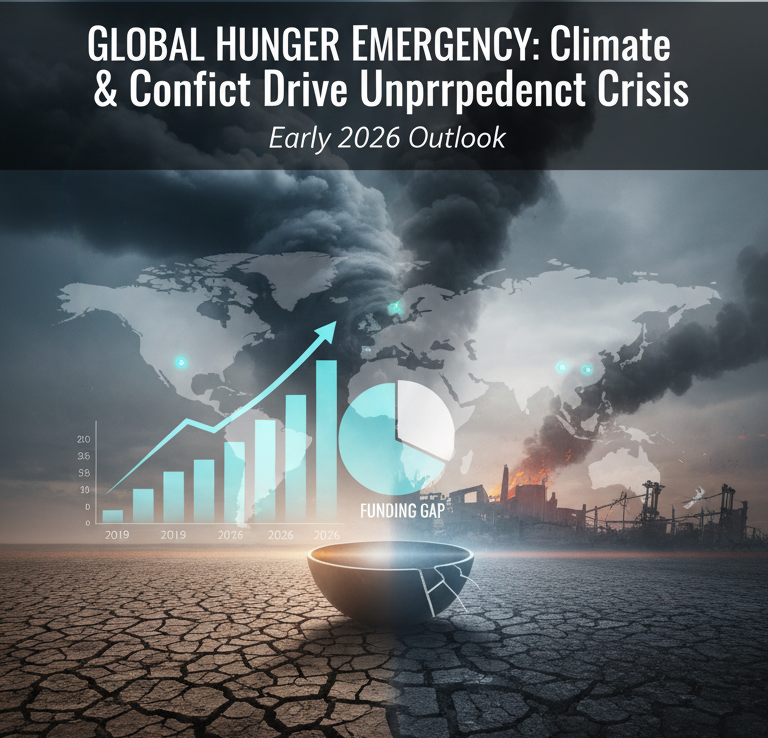
International organizations have issued urgent warnings about a deepening global food security crisis in early 2026, with 318 million people experiencing crisis levels of hunger or worse. This figure is more than double the number recorded in 2019. The crisis is driven by a combination of ongoing conflicts, intensifying climate change, pervasive economic instability, and a critical shortfall in humanitarian funding, leading to declared famines in multiple regions.
II. The Escalating Scale of Acute Hunger in Early 2026
A. A Stark Global Outlook
The World Food Programme’s (WFP) 2026 Global Outlook projects that approximately 318 million people will face crisis levels of hunger (IPC Phase 3) or worse in the coming year. Of these, 41 million people across 51 countries are expected to confront Emergency levels (IPC Phase 4+) of acute food insecurity, one step away from famine.
This represents a significant increase: Action Against Hunger reported 295 million people facing acute food insecurity across 59 countries in 2024, the highest number since the Global Report on Food Crises (GRFC) began in 2016. A joint FAO-WFP report from November 2025 forecasts worsening acute food insecurity in 16 countries and territories between November 2025 and May 2026. West and Central Africa alone are expected to see 55 million people face crisis levels of hunger or worse during the June-August 2026 lean season.
III. Famines Declared: Critical Hotspots on the Brink
A. Unprecedented Famines in the 21st Century
For the first time in the 21st century, two simultaneous famines have been confirmed in parts of Gaza and Sudan, according to the WFP’s 2026 Global Outlook. WFP Executive Director Cindy McCain described this as unacceptable in an age of abundant resources.
B. Identified Global Hunger Hotspots
Action Against Hunger’s 2026 Global Hunger Hotspots report, published January 21, 2026, identifies 10 nations facing extreme hunger:
- Nigeria (31.8 million people)
- Sudan (25.6 million)
- Democratic Republic of Congo (25.6 million)
- Bangladesh (23.6 million)
- Ethiopia (22 million)
- Yemen (16.7 million)
- Afghanistan (15.8 million)
- Myanmar (14.4 million)
- Pakistan (11.8 million)
- Syria (9.2 million)
Contextually critical regions due to the proportion of their population affected include the Gaza Strip (94% acute food insecurity), South Sudan (56%), and Haiti (56%). The FAO-WFP November 2025 report further identifies Sudan, Palestine, South Sudan, Mali, Haiti, and Yemen as being at the highest risk of famine or catastrophic hunger.
IV. The Converging Drivers of Crisis
The global hunger emergency is a result of interconnected crises.
A. Conflict and Violence: The Predominant Engine of Hunger
Conflict is the primary driver of acute food insecurity, with nearly 70% of those affected in 2025 residing in countries with fragility or conflict. Of the 16 hunger hotspots, 14 cite conflict and violence as the main cause. Conflict disrupts food production and supply chains, displaces populations, and impedes humanitarian access. Key affected regions include the Middle East, East, Central, and West Africa, the Caribbean, Southern Asia, and Eastern Europe.
B. Climate Change: Exacerbating Vulnerabilities
Climate change is a major factor in the rise of global hunger. Increased frequency and severity of climate shocks (droughts, floods, storms) destroy lives, crops, livelihoods, and communities’ ability to feed themselves. A study in Scientific Reports (January 2026) reinforces climate’s significant role. Recent examples include Hurricane Melissa devastating parts of Jamaica, Haiti, and Cuba, and a 60% decline in Syria’s crop production largely due to climate factors.
C. Economic Instability and Systemic Challenges
Widespread economic instability, including persistently high inflation, has reduced purchasing power. High debt burdens in developing nations and an uneven global economic recovery impact national and household food security, leading to increased food prices that make staples unaffordable for the vulnerable.
V. The Humanitarian Funding Shortfall: A Crisis of Resources
A. Aid Agencies Strained Amidst Surging Needs
Global humanitarian needs are at unprecedented levels, while funding has dramatically reduced. Humanitarian aid currently covers less than half of total needs. The WFP requires an estimated US$13 billion to assist 110 million vulnerable people in 2026 but forecasts receiving less than half of this amount. This shortfall forces aid organizations to implement deep ration cuts, scale back programs, and make difficult prioritization decisions. Action Against Hunger’s 2024 “Hunger Funding Gap” report noted a 65% shortfall in funding for hunger-related programs.
VI. Beyond Visible Famine: The Silent Scourge of Hidden Hunger
A. The Pervasive Threat of Micronutrient Deficiencies
“Hidden hunger,” or micronutrient deficiencies, silently affects billions. This lack of essential vitamins and minerals devastates health and development, weakens health systems, stunts economic growth, and perpetuates poverty. Nearly 30 million children in analyzed contexts suffer from acute malnutrition, with 8.5 million experiencing severe malnutrition. At least 13 million pregnant or breastfeeding women are malnourished, impacting their health and their children’s development.
VII. Pathways to Action: Innovating and Collaborating for Food Security
International organizations are employing innovative strategies and advocating for global solidarity.
A. WFP’s Operational Response and Innovative Solutions
The WFP aims to assist 110 million people in 2026 despite funding challenges. They are using AI-powered tools like SCOUT for supply chain optimization and digital cash transfers for recipient empowerment and aid efficiency. The WFP is also implementing anticipatory action strategies to protect lives and livelihoods before disasters, noting that every dollar invested in anticipatory action can save seven dollars in losses.
B. Urgent Call for Global Solidarity and Coherence
The crisis demands an urgent, united response. Cindy McCain calls for increased support for effective solutions. Charles Owubah highlights the “unprecedented convergence of crises” requiring coordinated efforts. The WFP emphasizes that food assistance provides life-saving relief, stability, dignity, and hope. There is a call for greater coherence in political commitments, funding, and interventions across humanitarian, development, and peace initiatives.
VIII. Conclusion: A Shared Responsibility for a Food-Secure Future
The early months of 2026 highlight the critical and unprecedented depth of the global food security crisis, with declared famines in Gaza and Sudan and 318 million people facing crisis levels of hunger. Climate, conflict, and economic factors create a devastating web requiring holistic solutions. Urgent action, sustained funding, political will, and a collective international effort are necessary to prevent preventable famines and ensure basic food security, dignity, and hope for all.