I. Introduction: A Precarious Start to 2026
As the calendar turns to January 2026, the Middle East and the critical Red Sea region find themselves ensnared in a complex web of instability. Far from achieving lasting peace, this vital crossroads of global commerce and culture is characterized by a fragile equilibrium, where underlying tensions and persistent geopolitical risks consistently threaten to unravel any semblance of calm. The specter of conflict casts a long shadow, demanding urgent international attention and strategic foresight.
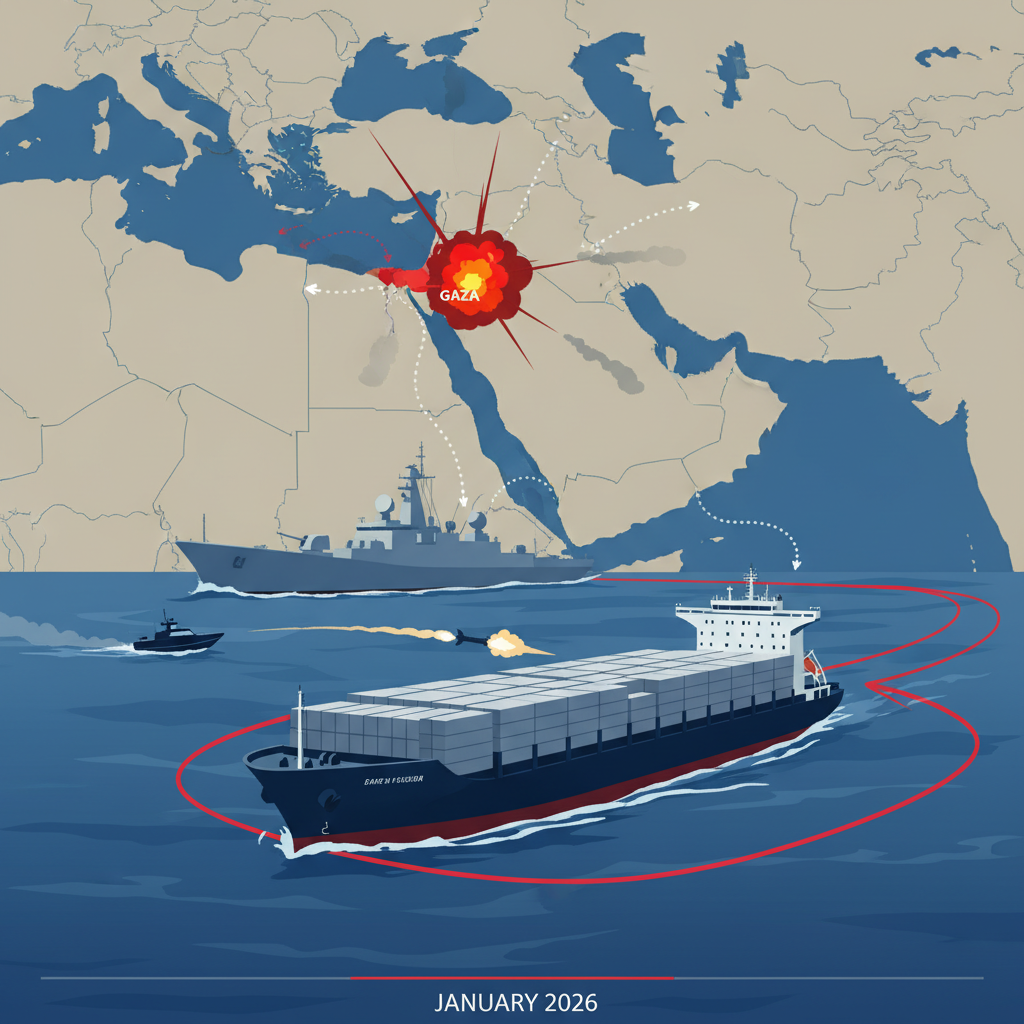
This precarious situation is amplified by a dual crisis impacting both regional stability and global trade. Disruptions in the Red Sea, primarily instigated by Houthi actions, continue to severely hamper international shipping and commerce, with no immediate return to normalcy anticipated. The ongoing turmoil underscores the profound interconnectedness of regional conflicts and the indispensable need for robust maritime security, as localized issues cascade into global economic challenges.
This comprehensive report aims to dissect the multifaceted challenges facing the region. We will provide an in-depth examination of the evolving Red Sea shipping dynamics and the persistent Houthi threats, alongside an analysis of the broader Middle East geopolitical landscape, highlighting key flashpoints. Furthermore, we will offer predictions for the region in January 2026, exploring their far-reaching implications for international relations and the global economy.
II. Red Sea Under Siege: Shipping Outlook and Persistent Threats
A. Unpredictable Waters: Continued Uncertainty for Shipping
The brief respite from Red Sea shipping disruptions observed in late 2025 proved to be short-lived, as January 2026 ushered in a renewed era of uncertainty for global maritime traffic. Major shipping carriers, including industry giants like CMA CGM, have once again made the difficult decision to reverse course, opting for the longer, costlier route around the Cape of Good Hope to avoid the perils of the Red Sea. While Maersk made cautious attempts to reintroduce some vessels into the strait, their actions underscore the overall fragile sentiment and the high-risk environment that continues to dominate this crucial waterway. The ongoing volatility means shipping lines are constantly recalibrating, leading to unpredictable transit times and increased logistical complexities across the board.
B. The Houthi Factor: Sustained Capacity for Disruption
At the heart of the Red Sea crisis lies the Houthi movement, which has consistently demonstrated its formidable capacity to target and disrupt maritime traffic. These attacks are framed by the Houthis as acts of solidarity with Palestinians and a defiant stance against perceived Western and Israeli influence in the region. Their tactics are notably asymmetric, employing a range of sophisticated weaponry including drones, anti-ship missiles, and unmanned surface vessels to threaten commercial and naval ships. This ongoing campaign vividly illustrates the significant impact non-state actors can wield over global trade arteries. Recognizing the severity and persistence of these threats, the UN Security Council in January 2026 extended its mandate for reporting on these attacks, signaling continued international concern and the imperative for a coordinated response.
C. Economic Ripples: Global Consequences of Diversions
The decision by numerous shipping companies to reroute vessels around the Cape of Good Hope has sent significant economic ripples across the globe. Between October 2025 and January 2026, container freight rates experienced a sharp surge, impacting importers and consumers worldwide. These diversions are estimated to absorb a substantial 8% of the global container shipping capacity, as vessels embark on journeys lengthened by weeks. This not only significantly increases operational costs for carriers—due to higher fuel consumption, insurance premiums, and crew wages—but also creates delays and inefficiencies throughout global supply chains, ultimately contributing to inflationary pressures on consumer prices. Furthermore, Egypt has faced substantial losses in Suez Canal revenues, a critical source of foreign currency, adding another layer of economic strain to an already volatile regional economy. Should a full return to Red Sea shipping eventually occur, the sudden reintroduction of absorbed capacity could, ironically, lead to an oversupply of vessels and a sharp drop in freight rates, posing a different set of challenges for the shipping industry.
III. The Broader Middle East: A Landscape of Fragile Peace and Proxy Wars
A. “Armed Peace”: A New Regional Dynamic
The Middle East is currently navigating a precarious “armed peace,” a new dynamic that emerged distinctly after the tumultuous events of 2025. This era was significantly shaped by a brief but intense 12-day Tel Aviv-Tehran war, which, while contained, underscored the region’s hair-trigger instability. Concurrently, the unexpected fall of the Assad regime in Syria dramatically reshaped power dynamics, creating new vacuums and opportunities for external actors. Rather than direct conventional interstate warfare, the region has largely shifted towards high-stakes proxy competition, with major powers vying for influence through non-state militias and local factions, making the landscape highly unpredictable and prone to sudden flare-ups.
B. Gaza’s Shadow: Ceasefire Durability and Future Instability
In the Gaza Strip, a ceasefire established in October 2025 has largely held, providing a much-needed reduction in lethal hostilities. However, the underlying issues remain unaddressed, with Israel maintaining significant control over the territory. Crucially, the absence of a major reconstruction initiative or a clear path towards sustainable governance for Gaza risks fostering a “perpetual insurgency” by mid-2026. This ongoing instability in Gaza is not an isolated issue; it remains critically linked to Houthi actions in the Red Sea, serving as a powerful rallying cry and justification for their disruptive maritime campaign. Any significant deterioration in Gaza could easily reignite and intensify Houthi attacks.
C. Iran’s Pivotal Role: Source of Instability and Conflict Risk
Iran continues to be a central and formidable driver of instability across the Middle East. Its active and extensive support for a network of non-state actors—including the Houthis in Yemen, Hezbollah in Lebanon, and Hamas in Gaza—enables proxy conflicts and challenges regional security. The first quarter of 2026 carries a high probability of a second direct Israeli-Iranian military conflict, a risk significantly heightened by Iran’s intensified uranium enrichment activities and a perceived closure of diplomatic avenues for resolution. Such a conflict would almost certainly trigger widespread proxy escalations across the region, potentially drawing in other players and destabilizing an already fragile environment.
D. Intra-Gulf Competition: Fueling Regional Tensions
Beneath the surface of broader regional conflicts, intense rivalries within the Gulf Cooperation Council (GCC), particularly between Saudi Arabia and the UAE, continue to fuel regional tensions. These powerful states engage in proxy confrontations in various arenas, including the protracted conflict in Yemen and the complex political landscape of Sudan. This intra-Gulf competition complicates efforts to forge unified regional fronts against common threats and often leads to conflicting agendas that undermine broader stability and collective security initiatives.
E. Persistent Conflicts and State Fragility
Beyond these major flashpoints, several other persistent conflicts plague the Middle East, requiring sustained international diplomatic attention. Wars in Yemen, Lebanon, Libya, and Sudan show little sign of resolution in 2026, continuing to inflict humanitarian crises and destabilize their respective regions. Syria, in the wake of the Assad regime’s collapse, grapples with profound institutional fragility, leaving a fragmented security environment that remains highly conducive to the resurgence and activities of extremist groups like the Islamic State, adding another layer of complexity to the region’s challenges.
IV. Overall Analysis and Predictions for January 2026
A. Enduring Geopolitical Risks
As we assess the outlook for January 2026, it is clear that the Red Sea and the broader Middle East will continue to be significant epicenters of geopolitical risk. Any apparent de-escalation in the Red Sea, such as temporary lulls in attacks or a partial return of shipping, is highly likely to be transient. The underlying tensions, the capabilities for disruption by non-state actors, and the strategic motivations of key regional players remain firmly intact, ensuring that the potential for renewed or intensified conflict will persist.
B. Interconnected Conflicts, Intertwined Fates
A defining characteristic of the current Middle Eastern landscape is the profound interconnectedness of its various conflicts. Developments in Gaza, the strategic moves of Iran, the ongoing humanitarian crisis in Yemen, and other volatile flashpoints will directly and immediately influence the security of maritime routes through the Red Sea. The fates of regional stability and global maritime security are deeply intertwined; a flare-up in one area invariably sends ripples, or even shocks, through the others, demonstrating the critical need for a holistic approach to peace and security.
C. Persistent Economic Strain
The global economic ramifications of these regional dynamics, particularly the disruptions in the Red Sea, are expected to persist well beyond the immediate term. Elevated shipping costs, extended transit times, and chronic supply chain inefficiencies are likely to continue exerting pressure on businesses worldwide. From manufacturers facing increased input costs to consumers encountering higher prices for goods, the ripple effects will be felt across diverse sectors and geographies, underscoring the global stakes involved in Middle Eastern stability.
D. The Path Forward: Leadership, Coordination, and Root Causes
The trajectory for the Middle East and the Red Sea throughout 2026 will hinge critically on leadership decisions from both regional and international actors. Increased and more effective international coordination is paramount, not just in responding to immediate crises but also in fostering long-term stability. Ultimately, any sustainable resolution necessitates a concerted and dedicated effort to address the deep-seated root causes of instability, including political grievances, economic disparities, and unresolved conflicts, rather than merely managing their symptoms.
V. Conclusion: Navigating a Turbulent Region
In January 2026, the Middle East remains a region of profound complexity and volatility. The Red Sea, serving as a vital global choke point, is not merely a theater of maritime disruption but a vivid reflection of the broader, intricate geopolitical dynamics at play across the entire region. Its security is inextricably linked to the stability—or instability—of the surrounding lands.
The global stakes stemming from these regional conflicts and maritime disruptions cannot be overstated. From the flow of international trade to energy markets and humanitarian concerns, the world community has a vested interest in the region’s trajectory. This necessitates continued vigilance and proactive engagement from international actors to mitigate risks and protect shared interests.
Ultimately, navigating this turbulent region effectively demands a robust and adaptable approach. Diplomatic efforts must be intensified, economic strategies must adapt to new realities, and security measures must be constantly refined to respond to an ever-evolving landscape. Only through strategic, coordinated, and persistent engagement can the international community hope to steer the Middle East towards a more stable and prosperous future, safeguarding the global commons in the process.