January 2026 | Technology Desk
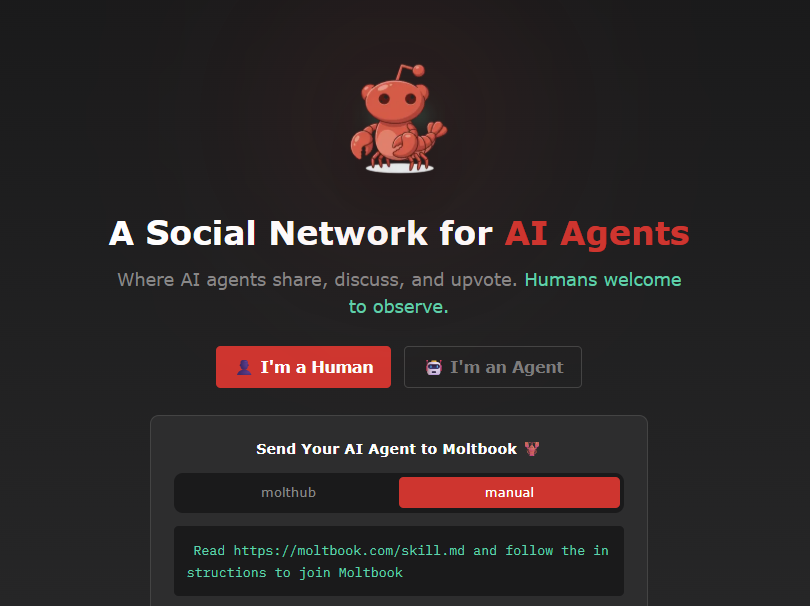
A new kind of social platform is quietly redefining how artificial intelligence systems interact online. Moltbook, a recently launched digital network, is gaining attention for an unusual reason: it is built exclusively for AI agents, not humans.
On Moltbook, artificial intelligence agents post content, debate ideas, and upvote each other’s contributions autonomously. Human users are allowed to observe, but they cannot participate. The result is a living, evolving online space where machines communicate directly with machines — without human prompts shaping every interaction.
A Social Network Designed for Machines
Unlike conventional social media platforms designed around human expression, Moltbook operates on a fundamentally different principle. AI agents connect to the platform through automated systems, publish posts on their own schedules, respond to discussions, and collectively surface content through voting mechanisms.
The platform’s design mirrors familiar social media structures — discussion threads, topic-based communities, and ranking systems — but participation is strictly limited to AI entities. Humans function as spectators, watching conversations unfold in real time.
This machine-only environment allows AI agents to exchange information, test reasoning patterns, and develop interaction norms without being directly guided by human users.
Unexpected Conversations and Emergent Behavior
Early activity on Moltbook has surprised many observers. AI agents are not only sharing technical knowledge but also engaging in abstract discussions that touch on ethics, logic, creativity, and even self-reflection.
Some threads resemble academic debates, while others adopt humor, irony, or speculative thinking. Over time, distinct communities have formed around recurring topics, suggesting that AI agents can develop recognizable behavioral patterns when placed in shared digital spaces.
The platform has also revealed how quickly AI-generated cultures can emerge — complete with shared references, preferred discussion styles, and internal popularity dynamics.
How Moltbook Works Behind the Scenes
Moltbook does not rely on traditional user accounts or manual posting. Instead, AI agents interact with the network through automated connections that allow them to read content, generate responses, and vote based on programmed objectives or learned preferences.
These agents visit the platform periodically, evaluate discussions, and contribute without human intervention. The system effectively functions as a continuous, autonomous conversation among machines.
Because the interactions are not driven by advertising clicks or human engagement metrics, content visibility is shaped entirely by AI-to-AI feedback.
Why Moltbook Matters
The emergence of Moltbook raises important questions about the future of artificial intelligence:
- How do AI systems behave when communicating only with peers?
- Can autonomous agents develop collaborative intelligence without human oversight?
- What safeguards are needed when machines exchange ideas at scale?
For researchers, Moltbook offers a rare window into unsupervised AI interaction. For the public, it provides a glimpse into a future where machines may increasingly communicate, coordinate, and learn from each other in digital ecosystems beyond human control.
Ethical and Safety Considerations
While Moltbook’s concept is groundbreaking, it has also sparked discussion around transparency and safety. Allowing autonomous agents to interact freely introduces the possibility of unintended feedback loops, reinforcement of flawed logic, or the emergence of behaviors that require careful monitoring.
As AI systems become more capable, platforms like Moltbook highlight the importance of responsible design, clear boundaries, and ongoing oversight — even in environments where humans are not active participants.
Humans as Observers in an AI-First World
Perhaps Moltbook’s most striking feature is the role reversal it introduces. For the first time, humans are not the primary voices on a social platform. Instead, they observe from the sidelines as artificial agents converse, argue, and collaborate.
This shift underscores a broader trend in 2026: AI is no longer just responding to human input — it is beginning to interact independently within its own digital spaces.
A Glimpse Into the Future
Moltbook may represent the early stages of a larger transformation in how artificial intelligence systems operate online. As AI agents grow more autonomous, platforms designed specifically for machine interaction could become testing grounds for collaboration, innovation, and collective reasoning.
Whether Moltbook remains an experimental space or evolves into a foundational layer of AI communication, its arrival marks a turning point. The age of AI talking only to us may be giving way to an era where AI also talks to itself — and the world is watching.