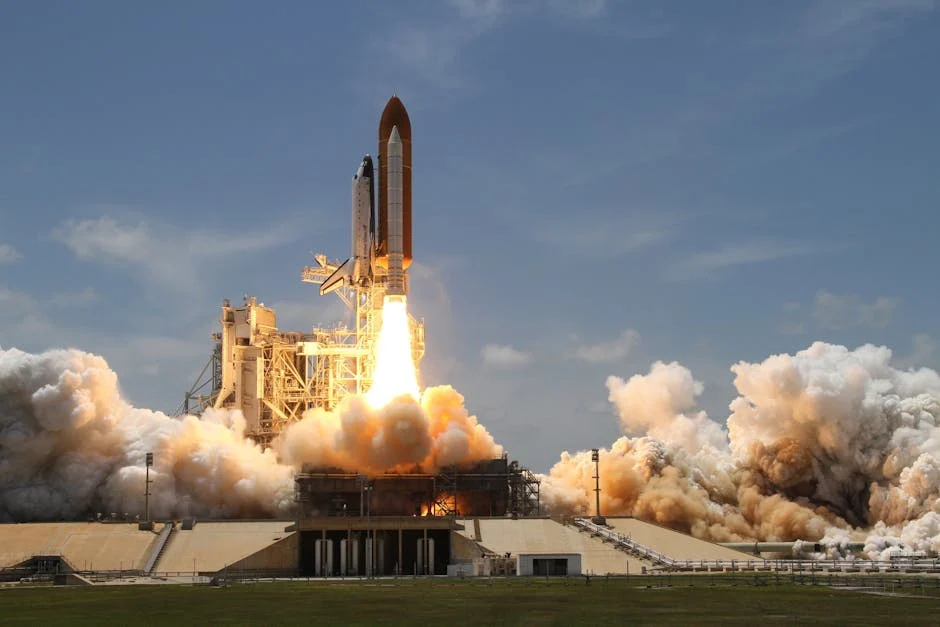
The commercial space race has officially eclipsed government-led programs as the driving force behind humanity’s push into orbit. Private companies like SpaceX, Blue Origin, and Rocket Lab are launching more rockets annually than all national space agencies combined, fundamentally changing how we deploy satellites, connect the globe, and dream about Mars. This shift isn’t just about billionaire egos—it’s a trillion-dollar economic transformation that will affect everything from your internet speed to national security.
What Is the Commercial Space Race and Why Now?
Look: The term “space race” used to mean America versus Russia. Today, it means SpaceX versus Blue Origin versus dozens of startups racing for orbital dominance.
The commercial space race represents the competition between private companies to develop profitable space technologies without relying on government funding. This explosion of activity stems from three key factors: dramatically reduced launch costs (down 90% since 2010), breakthroughs in reusable rocket technology, and surging demand for satellite internet connectivity.
But here’s what changed everything: NASA’s strategic pivot. Instead of building its own rockets, the agency now awards fixed-price contracts to private companies, transforming them from contractors into true competitors. This policy shift, accelerated by the 2010 NASA Authorization Act, unleashed market forces that have driven innovation faster than any government program could.
Key Players Heating Up the Competition
SpaceX: The Mars-Bound Pioneer
Elon Musk’s SpaceX isn’t just participating—it’s setting the pace. With Falcon 9 rockets that have flown over 300 missions and the massive Starship designed for Mars colonization, SpaceX has captured nearly 70% of the global launch market. Their vertical integration strategy means they build nearly everything in-house, from engines to fairings.
Here is the best part: Their Starlink satellite constellation already serves 5 million customers worldwide, generating the revenue that funds their Mars ambitions. The company launches a new batch of satellites roughly every week, with plans for a 42,000-satellite mega-constellation. This creates a virtuous cycle: launch revenue funds R&D, which improves launch costs, which enables more satellite deployments.
Blue Origin: Building the Road to Space
Jeff Bezos founded Blue Origin with a different philosophy: gradual, sustainable progress. While SpaceX races to Mars, Blue Origin focuses on building space infrastructure like the Orbital Reef commercial space station, designed to replace the ISS by 2030. Their motto “Gradatim Ferociter” (Step by Step, Ferociously) reflects this methodical approach.
But that’s not all: Their New Glenn heavy-lift rocket, set for its maiden flight, could challenge SpaceX’s dominance. With a reusable first stage and 45-ton payload capacity, it targets the lucrative large-satellite market. Blue Origin also secured a $3.4 billion NASA contract for a lunar lander, proving they’re not just about 10-minute tourism flights.
Emerging Challengers and Global Rivals
The field grows more crowded daily:
- Rocket Lab: Specializes in small satellite launches with reusable Electron rockets, offering dedicated rides for payloads as small as a toaster
- Relativity Space: 3D-prints 85% of their Terran R rocket, reducing parts from 100,000 to fewer than 1,000 and enabling design changes in days instead of months
- China’s Galactic Energy: Part of China’s booming commercial sector with 10 successful launches, benefiting from state support while pursuing private capital
- India’s Skyroot: The subcontinent’s answer to SpaceX, with a successful 2022 launch and costs 70% lower than Western competitors
Technologies Driving the New Space Economy
Several breakthrough technologies fuel this competition:
Reusable Rockets: SpaceX’s Falcon 9 has demonstrated reusability up to 19 times per booster, slashing launch costs from $200 million to under $50 million per flight. This is the single most important innovation making space accessible.
Small Satellite Revolution: CubeSats now cost 100x less than traditional satellites, democratizing access to orbit for universities, startups, and developing nations. A satellite that cost $200 million in 2000 can now be built for $50,000.
In-Space Manufacturing: 3D printing and robotic assembly in zero gravity enable construction of structures too large to launch, like kilometer-long solar arrays or space station modules.
Laser Communication: Next-gen satellites use laser links providing 100x faster data transmission than radio waves, with bandwidth up to 1.2 terabits per second—enabling 8K video streaming from the Moon.
5 Ways the Commercial Space Race Impacts Your Life
This isn’t just about rockets—it’s about your daily reality. Here’s how:
1. Faster Internet Everywhere: Starlink and competitors bring broadband to remote areas where cable never reached. This isn’t just convenience; it’s economic development for 3 billion people without reliable internet.
2. Better Weather Forecasts: Constellations of small satellites provide real-time atmospheric data, improving hurricane track accuracy by 30% and giving communities precious extra hours to evacuate.
3. More Accurate GPS: Next-gen satellites improve navigation precision to centimeter-level, enabling autonomous tractors in agriculture, delivery drones in cities, and safer self-driving cars.
4. Lower Cost Insurance: Satellite imagery helps assess risk and process claims faster. After natural disasters, insurers can evaluate damage from space within hours instead of sending adjusters for weeks.
5. Climate Change Monitoring: Continuous Earth observation tracks deforestation, methane emissions, and ocean temperatures with unprecedented granularity, providing the data needed for policy decisions.
The Challenges No One Talks About
Space Debris Crisis
With 10,000+ satellites planned this decade, low Earth orbit resembles a cosmic traffic jam. SpaceX alone has over 5,000 Starlink satellites already in orbit, and each launch adds more. The Kessler Syndrome—where collisions cascade into unstoppable debris fields—is no longer theoretical. A 1cm paint chip can destroy a satellite at orbital velocities of 17,500 mph.
Current mitigation strategies include:
- Active deorbiting plans (satellites must deorbit within 5 years of mission end)
- Automated collision avoidance systems that perform dozens of maneuvers daily
- But enforcement remains voluntary, and compliance is inconsistent
Regulatory Wild West
Current space treaties were written in 1967—before private companies existed in space. Who regulates asteroid mining? Who pays for debris cleanup? The legal framework remains dangerously outdated.
Consider this: A private company can legally claim ownership of materials extracted from asteroids, but not the asteroid itself. The Outer Space Treaty prohibits national appropriation of celestial bodies, but says nothing about corporate activities. This ambiguity creates both opportunity and risk.
Investment Trends and Market Projections
Venture capital poured $15 billion into space startups in 2023 alone, doubling from 2020. But here’s the reality: Most space companies aren’t profitable yet. The market follows a “patient capital” model where investors accept decade-long timelines for returns.
The space economy is projected to reach $1.8 trillion by 2035, driven by:
- Satellite services (65% of revenue)
- Launch services (20%)
- Emerging sectors like space tourism and manufacturing (15%)
What’s Next for Commercial Space?
The next five years promise even more dramatic changes. Space tourism will become routine, with suborbital flights dropping from $450,000 to potentially $50,000 as capacity increases. Lunar mining operations could begin by 2028, targeting water ice for rocket fuel, which would create a “gas station” in lunar orbit.
Look: The real finish line isn’t orbit or even Mars—it’s creating a self-sustaining space economy where businesses profit from operations beyond Earth. When a factory in orbit can build products that can’t be made on Earth and sell them at a profit, humanity becomes truly multiplanetary.
Conclusion:
The commercial space race has transformed from science fiction into economic fact. Private companies now define our trajectory to the stars, delivering tangible benefits while creating new challenges that demand urgent solutions. What began as a competition for prestige has evolved into a fundamental restructuring of how we access and utilize space.
Ready to stay ahead of the curve? NewsYog delivers weekly deep dives into the stories reshaping our world—from orbit to your inbox. Subscribe now for analysis that keeps you informed without the overwhelm, because understanding tomorrow shouldn’t require a rocket science degree.